
Matrice 4 in Urban Field Capture: What Really Matters When
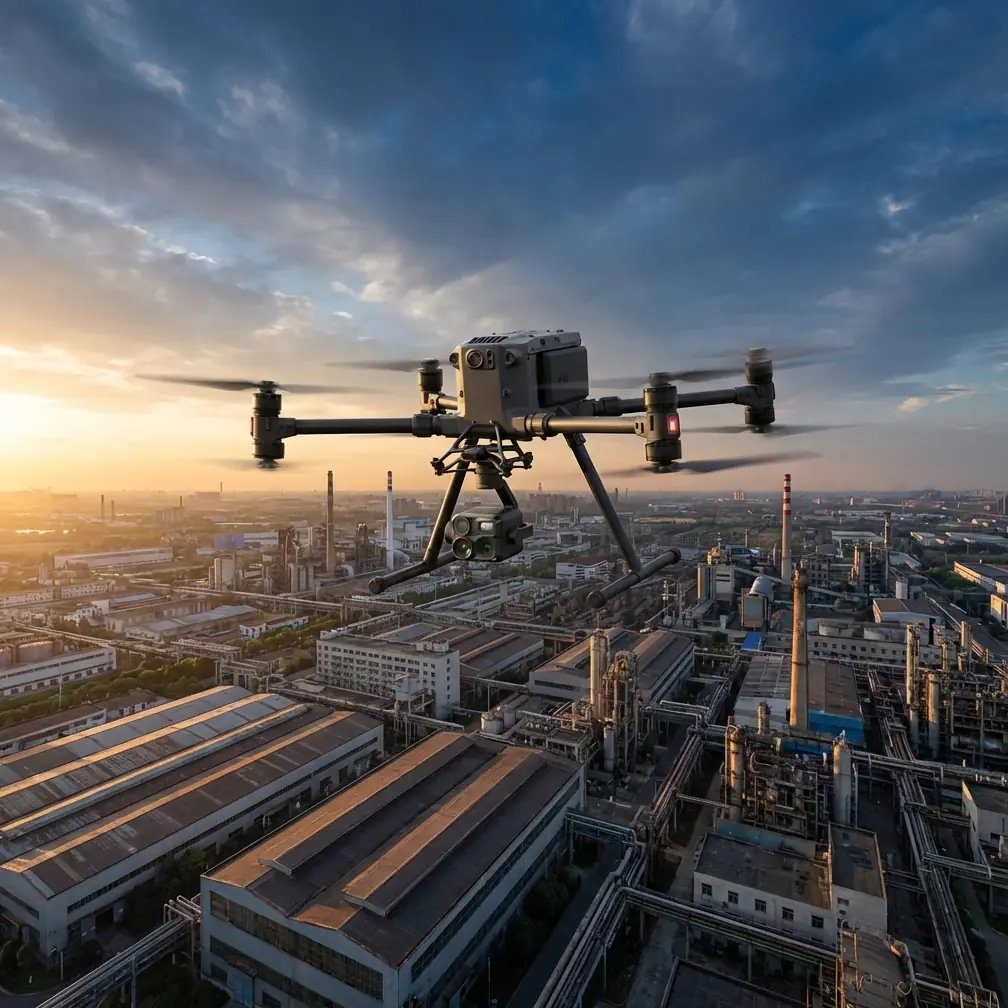
Matrice 4 in Urban Field Capture: What Really Matters When EMI, Shock Loads, and Noise Enter the Picture
META: A technical review of Matrice 4 for urban field capture, with practical insight on electromagnetic interference, shock isolation, transmission stability, thermal workflows, and why aircraft vibration and noise principles still matter.
Urban field capture sounds straightforward until you actually fly it.
A site may be open enough for clean photogrammetry, yet boxed in by reflective glass, rooftop HVAC systems, telecom equipment, power distribution hardware, traffic corridors, and the constant RF clutter that turns a routine mapping mission into a signal-management exercise. This is where a Matrice 4 platform has to be judged less by brochure-level capability and more by how well it behaves when the environment is messy.
I approach the Matrice 4 from that perspective: not as a generic enterprise drone, but as a working tool for capturing fields inside or adjacent to urban infrastructure, where electromagnetic interference, vibration exposure, payload stability, and data integrity all intersect.
The interesting part is that some of the most useful engineering lessons do not come from drone marketing at all. They come from older aircraft design principles. Two reference points stand out. One deals with how a single-degree-of-freedom system responds to acceleration pulse shock, and the other with cabin noise behavior across frequency bands, including measured A-weighted levels around 75 dBA for one aircraft dataset and as high as 97 dBA in another. Those numbers are not about drones directly, but they frame an essential truth: aircraft systems live or die by how well they manage disturbance energy, whether that energy arrives as vibration, shock, or acoustic excitation.
That matters for Matrice 4 more than many operators realize.
Urban capture is not just about camera quality
When readers search for Matrice 4 guidance, they usually start with sensor questions: Is the thermal signature usable for utility corridors? How reliable is the photogrammetry output over mixed surfaces? Does the transmission system hold up near steel structures? Those are valid questions, but urban field capture introduces a deeper systems problem.
A drone in this setting is not merely “taking pictures.” It is stabilizing multiple subsystems while moving through a disturbance-rich environment:
- GNSS quality can degrade near buildings.
- Compass confidence can swing when reinforced concrete and metal structures distort local magnetic conditions.
- Radio links may face multipath reflection.
- Fine camera alignment matters more because urban jobs often require precise edge definition near roads, rooftops, fencing, drainage lines, and irregular boundary features.
- Repeated takeoff and landing cycles increase the operational value of hot-swap batteries and workflow discipline.
A Matrice 4 mission that looks successful on-screen can still underperform later if the dataset shows inconsistent overlap, subtle yaw instability, thermal blur from rushed transitions, or degraded transmission confidence that forced conservative flight paths.
That is why the handling characteristics matter just as much as the payload.
The hidden lesson from shock-response theory
One reference document discusses a single-degree-of-freedom system under acceleration pulse shock and points to response-spectrum methods for selecting isolator characteristics such as spring stiffness. Buried in that material is a practical engineering insight: when the equivalent pulse duration becomes small relative to system timing, the peak response can rise sharply. In simple terms, short, abrupt inputs can produce disproportionately high system reactions.
Why should a Matrice 4 operator care?
Because drone payload quality depends on isolation from exactly these kinds of transient inputs. Urban field capture is full of them. Hard case transport over rough roads. Fast placement onto uneven ground. Aggressive climb-outs near obstructions. Abrupt braking to reassess line-of-sight. Wind shear spilling around building corners. None of these may look dramatic, yet each introduces short-duration excitation into the airframe and gimbal system.
Operational significance: if the disturbance is brief and sharp, the system can react more strongly than the pilot expects. That does not necessarily mean visible failure. More often it shows up as tiny penalties:
- momentary camera settle time after a maneuver
- reduced sharpness at the start of a capture leg
- slight thermal registration inconsistency
- more variation in tie-point confidence during photogrammetry processing
This is one reason I recommend treating the first seconds after a major control input as “data-expensive” unless the platform has fully settled. With Matrice 4, that means building capture discipline around smooth entries into survey lines rather than trusting raw stabilization to solve every motion problem instantly.
The shock reference also emphasizes using a response spectrum to determine isolator characteristics. For a drone operator, the translation is straightforward: isolation is not a binary feature. It is a tuning problem. Even if Matrice 4 arrives as an integrated platform, your handling, mounting checks, case transport habits, and payload inspection routine all affect whether the system behaves like a well-isolated sensor or a barely-contained one.
EMI is the real urban test, and antenna adjustment is not optional
Let’s get to the issue that causes the most confusion in dense capture zones: electromagnetic interference.
In urban field operations, EMI rarely announces itself with a dramatic warning. It starts subtly. Video latency feels inconsistent. Signal bars fluctuate near a structure that looked harmless during preflight. The aircraft yaws slightly as you rotate for a reframe. The transmission link recovers when you sidestep five or six meters. A pilot unfamiliar with RF behavior may blame weather, satellites, or “just a weird day.”
Usually, it is geometry.
With Matrice 4 and an O3-class transmission workflow, antenna orientation and body position still matter. A strong radio system cannot fully defeat poor antenna discipline in a reflective environment. Around urban fields, especially those bounded by buildings or infrastructure, I advise pilots to think in terms of lobe placement rather than simply “pointing the controller at the drone.” The goal is to maintain the strongest effective radiation pattern toward the aircraft while reducing self-shadowing and limiting reflective dead zones created by nearby structures.
Practical handling sequence:
- Before takeoff, identify likely EMI contributors: rooftop communications hardware, distribution cabinets, rail lines, large steel fencing, cellular installations, and mirrored facades.
- Choose a pilot position with cleaner sky view, not merely the nearest edge of the field.
- During climb, monitor link quality while yawing slowly; this can reveal directional sensitivity early.
- If instability appears, adjust antenna angle before relocating the whole operation.
- If the link improves after a small reposition, document that zone as a local interference pocket and avoid running your primary capture legs through the worst geometry.
Operational significance: antenna adjustment is often the quickest way to restore transmission margin without interrupting the mission. In urban fields, this is not a minor technique. It is a core competency.
And when clients ask why one operator finishes faster with fewer interruptions, this is usually part of the answer.
Why acoustic data from manned aircraft still says something useful
The second reference concerns cabin noise control in civil aircraft and includes octave-band spectral data and A-weighted sound levels. One dataset indicates about 75 dBA, while another reaches 97 dBA. It also notes approximate values and compares inside-versus-outside sound pressure differences, with one table showing cabin interior figures such as 76 dBA and 88 dBA depending on aircraft type.
Again, these are not drone measurements. But they remind us that airborne platforms are constantly shaped by frequency-dependent energy, not just gross decibel totals. Different frequencies penetrate structures differently, excite components differently, and alter human perception differently.
What does that mean for Matrice 4 field capture?
First, noise is a proxy for system energy. In rotorcraft operations, the frequencies you hear often correspond to the frequencies your sensors must survive. A drone operating near hard urban surfaces experiences reflected acoustic and aerodynamic energy that can subtly affect operator judgment, voice coordination, and even how easily abnormalities are detected by ear.
Second, urban operators often underestimate the value of listening to the aircraft. A stable Matrice 4 develops a recognizable acoustic signature. Changes in propeller loading, turbulence interaction, or mounting anomalies may appear in sound before they become obvious in imagery. The civil-aircraft reference’s focus on spectral behavior is a useful reminder that not all noise is equal. A shift in tonal character can mean more than a rise in overall loudness.
Third, when capture zones sit near occupied urban space, noise discipline is also a workflow issue. Faster setup, cleaner line planning, and fewer hover corrections reduce time-on-station. That helps both public tolerance and operational concentration.
Photogrammetry in urban fields: precision is earned, not assumed
Matrice 4 should be evaluated by the quality of what reaches processing, not just what the live feed suggests.
Urban fields are notoriously uneven from a mapping standpoint. You may have grass, reflective puddles, patchy dirt, curb edges, parked equipment, construction spoil, utility covers, and tree shadows crossing a single block. If you want reliable photogrammetry, the system must maintain stable overlap and consistent geometry while the operator controls for interference and changing light.
This is where GCP strategy still matters. Even with strong onboard positioning, urban constraints can create localized distortions. Ground control points placed at clean, visible locations near edges, elevation changes, and constrained corners remain one of the simplest ways to protect deliverable quality. The drone can be excellent and the mission can still need disciplined ground truth.
I also recommend separating thermal and photogrammetric objectives unless the client truly needs simultaneous compromise. Thermal signature work often wants different timing, speed, and interpretive context than pure geometry capture. For example, a roof edge or drainage path that appears obvious in RGB may behave very differently thermally after sun loading. Trying to force one flight profile to optimize both can dilute each result.
Data security and continuity are part of the technical review
Serious urban capture jobs increasingly involve sensitive sites: utilities, campuses, logistics yards, commercial roofs, private development parcels. That makes AES-256-style data protection relevant not as a checklist item, but as part of operational trust. Secure transmission and controlled data handling reduce friction with site managers and internal compliance teams.
Then there is continuity. Urban work often involves repeated short sorties rather than one long, uninterrupted mission. Hot-swap batteries matter here because they preserve rhythm. You can maintain capture momentum, keep lighting conditions more consistent across adjacent blocks, and reduce reset time between passes. The value is not convenience alone. It is dataset coherence.
BVLOS discussion also appears often around enterprise platforms, but in urban field capture the practical constraint is usually procedural and environmental rather than aircraft-only capability. Buildings, moving traffic, pedestrian exposure, and site fragmentation complicate the operating envelope quickly. The smarter conversation is not “Can Matrice 4 do BVLOS?” but “What mission architecture preserves image quality, link confidence, and compliance under actual urban conditions?”
That is a better question, and it leads to better planning.
A specialist’s field view of Matrice 4
If I were assessing Matrice 4 specifically for urban field capture, I would not center the review on headline specs. I would center it on resistance to cumulative penalties.
Can it hold a clean transmission link when the operator understands antenna geometry? Can it recover gracefully from local EMI without corrupting the mission plan? Can its stabilization and payload isolation preserve usable data after small but frequent disturbance inputs? Can the aircraft support both photogrammetry and thermal signature tasks without forcing awkward compromises? Can battery management keep the site moving efficiently?
Those questions reflect how the platform performs in real work.
The older aircraft references sharpen that view. The shock-response material tells us short-duration inputs can create outsized system response when timing relationships are unfavorable. The noise-control data, with values ranging from 75 dBA to 97 dBA in the cited examples, reminds us airborne systems are governed by frequency behavior, not just broad labels like “stable” or “loud.” In a drone context, those principles translate into better habits: smoother control inputs, stronger transport discipline, sharper preflight inspection, closer attention to tonal changes, and smarter antenna adjustment in interference-heavy zones.
That is the difference between flying a capable drone and extracting professional-grade results from one.
If you are planning a dense-site capture workflow and want a second opinion on mission design, antenna setup, or payload strategy, you can message a Matrice 4 specialist here.
Matrice 4 can be an excellent platform for urban field work. But the aircraft alone is never the whole story. The result depends on how well the pilot manages interference, disturbance energy, capture geometry, and operational tempo. In city-edge and city-core environments, that is where the mission is won.
Ready for your own Matrice 4? Contact our team for expert consultation.