
Matrice 4 in Low Light: A Practical Delivery Workflow
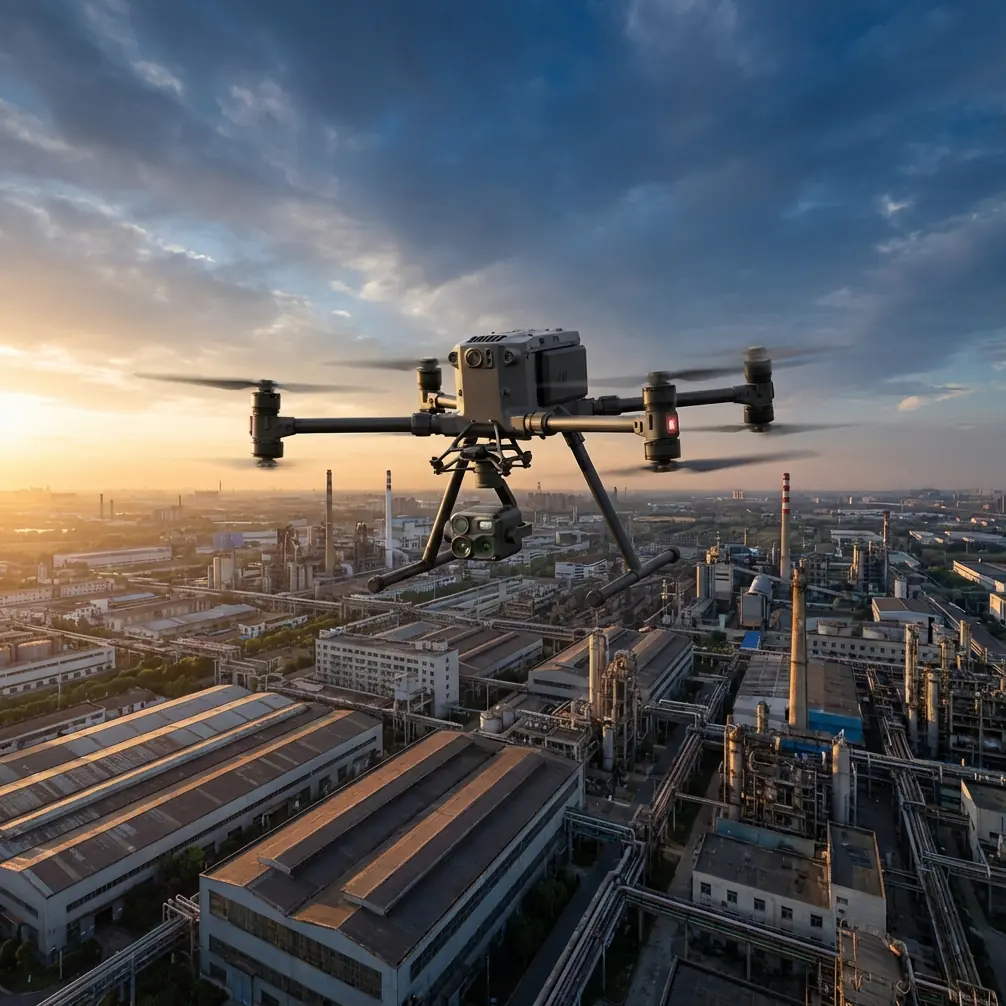
Matrice 4 in Low Light: A Practical Delivery Workflow for Construction Sites When Conditions Shift
META: Expert tutorial on using Matrice 4 for low-light construction site delivery, with operational insights on thermal signature awareness, O3 transmission, AES-256 links, battery planning, and weather changes mid-flight.
Low-light delivery on a construction site sounds simple until the site is wet, the access roads are blocked, the crane crews are still active, and the weather turns halfway through the mission.
That is where the Matrice 4 becomes interesting—not as a spec-sheet object, but as a working aircraft in a messy operating environment.
I’ve seen the same mistake repeated across infrastructure and building projects: teams think night or pre-dawn delivery is only about visibility. It isn’t. The real problem is systems reliability under compounded uncertainty. You are dealing with reduced contrast, shifting wind around structures, intermittent signal blockage, changing moisture levels, and the constant risk of misidentifying drop zones that look obvious in daylight but flatten into ambiguity after sunset.
For construction logistics, the Matrice 4 matters because it sits at the intersection of aerial transport, site awareness, and repeatable mission planning. If you are moving urgent tools, survey markers, radio equipment, inspection kits, or lightweight medical and safety supplies across a large work zone in low light, the aircraft has to do more than fly. It has to preserve control margin when the site stops behaving like the plan.
This tutorial is built around that reality.
Start with the site, not the aircraft
Before launch, define the delivery path as a construction systems problem.
Low-light delivery is rarely a straight-line mission. Steel framing, temporary office containers, tower cranes, concrete pump booms, netting, and partially enclosed structures all create airflow distortion and signal complications. In practical terms, that means your intended route should include:
- a primary corridor
- a fallback holding point
- a secondary approach to the drop zone
- a return path that avoids the same turbulence traps if wind shifts
This is where many operators underuse photogrammetry. Even for a delivery mission, a recent site model helps. If you already have a photogrammetry dataset tied to GCPs, you can compare the planned delivery lane against actual current site geometry rather than relying on a week-old memory of where scaffolds were placed. GCP-backed mapping is operationally significant because it reduces positional ambiguity at the handoff point. On a crowded project, being off by a few meters is not a minor issue; it can place a payload over rebar cages, pooled water, or active work fronts.
A low-light delivery route should also consider thermal signature behavior across the site. Fresh concrete, generators, vehicle engines, portable lighting towers, and recently used asphalt surfaces all radiate differently. If your workflow includes thermal-assisted situational awareness, those signatures can help confirm the real location of active crews and equipment. That matters because the safest drop zone on paper may be the wrong one in actual nighttime operations once labor and machinery migrate.
Why transmission stability becomes the real safety layer
People often focus on camera performance in low light first. I would put link stability ahead of it for delivery work.
On a construction site, especially one with dense structures or temporary metal installations, transmission quality determines whether the operator can confidently adapt when conditions change. O3 transmission is useful here not because it sounds advanced, but because stable situational feedback buys time. Time to reassess an approach. Time to hold. Time to reject a delivery attempt and divert.
That matters even more if your site logistics workflow is moving toward BVLOS operations under an approved framework. In visual line of sight missions, a local observer can sometimes compensate for partial signal degradation by giving the pilot immediate environmental context. In BVLOS or extended-range site workflows, the aircraft-to-operator data link carries more of the burden.
There is also a data governance angle that construction firms increasingly care about. AES-256 link security is not just an IT checkbox. On infrastructure, energy, or high-value commercial developments, delivery missions may reveal sensitive layout details, temporary access routes, staging areas, or installation progress. Protected transmission helps keep operational footage and telemetry within your risk controls.
A simple mission template for low-light delivery
Here is the workflow I recommend for a Matrice 4 deployment on an active construction site.
1. Conduct a twilight or pre-shift site scan
If possible, survey the route shortly before the actual delivery window. This gives you a live read on:
- standing water
- crane movement zones
- fresh obstructions
- lighting glare
- crew concentration points
- changing wind behavior around new structures
If rain has recently passed through, look closely at reflective surfaces. In low light, puddles on slab edges or membrane roofing can distort depth perception from the air.
2. Validate the drop zone with two references
Never approve a delivery point from visual imagery alone when the site is cluttered.
Use a mapped site reference—ideally tied to GCP control—plus a live operational confirmation from the receiving crew. In other words, your “correct” location should exist both in spatial data and in real-time site communication.
This two-reference method echoes a principle that engineers have understood for decades: loads and forces do not always move through the path you assume. In classical aircraft structural design, one of the source materials here describes how a triangular root skin panel may not carry shear flow if an adjacent boundary acts as a free edge. The torque then cannot transfer inward through that skin and must instead be passed to the root rib as a distributed moment. Operationally, the lesson is broader than aerostructures. What looks like a load path may not be the load path. On a construction site, what looks like the obvious drop point may not be the usable one. Confirm the true transfer path before committing the aircraft.
3. Establish a conservative battery rule
Hot-swap batteries are one of the most practical features in repeated site delivery cycles because they keep the aircraft turning missions around without long idle windows. But the mistake is treating hot-swap capability as permission to push every sortie deeper into the battery envelope.
For low-light work, reserve more than you would in daylight. Why? Because night returns often take longer. The approach may be rejected. The receiver may move. Weather may force a hold. Wind shear around buildings can rise unexpectedly after temperature changes. If your aircraft is operating near the margin when any of that happens, the mission gets narrow fast.
4. Brief the receiving crew like an airside team
Construction personnel are not automatically good drone receivers. They need a short, disciplined brief:
- where to stand
- where not to stand
- how to identify the aircraft
- what lighting to use or avoid
- what to do if the aircraft waves off
- how to secure the area during final descent or handoff
Good delivery performance is often less about pilot skill than about site discipline at the last 20 meters.
When the weather changes mid-flight
This is where polished plans tend to break.
Let’s say you launch just after dusk. Conditions are acceptable. The route is clear. Halfway through the delivery, a coastal breeze builds and starts interacting with the unfinished tower core. You see light mist begin to move across the upper deck. Site floodlights create haze and glare. The aircraft is still within the mission envelope, but the visual scene has degraded and the approach no longer looks as clean as it did six minutes earlier.
This is not the moment to “press on carefully.” It is the moment to use the system as intended.
With a stable O3 link, you hold at the predetermined point rather than improvising over the drop zone. You assess whether the receiver remains in position. You check whether the thermal signature of the intended handoff area still matches expectations or whether equipment and personnel have shifted. You compare the live image to your mapped route and confirm whether moisture or glare is hiding the true landing or release reference. If the site has a secondary approach lane, you use it. If not, you abort and recover.
That kind of discipline sounds obvious on paper. In reality, it is what separates professional construction drone operations from casual flying with a payload attached.
There is another relevant engineering lesson hidden in the reference material. The structural text notes that at a load intersection, it is not enough for the surrounding frame members to withstand the distributed moment; the connection strength at the actual joint must also be considered. The operational parallel is direct: it is not enough for each part of the mission to look adequate in isolation. The weak point is often the junction—handoff, final approach, weather transition, signal shadow, or crew coordination. That is where low-light delivery missions are won or lost.
Fuel-system thinking actually improves drone operations
One of the provided technical references comes from aircraft fuel system maintenance, specifically microbial contamination detection in fuel and field-use diagnostic methods. At first glance, that seems unrelated to a Matrice 4 delivery tutorial. It is not.
The useful principle is maintenance discipline under field conditions.
The source describes a practical detection workflow designed for use outside the lab, including observation every 24 hours and a one-week monitoring period, with severe contamination indicated by changes such as a red aerobic bottle within 48 hours or blackening in the anaerobic tube within one week. It also emphasizes water control, drainage, and contamination prevention in storage systems.
For drone teams, the transfer is conceptual but valuable. Site operations fail when contamination, moisture, and procedural shortcuts are treated as background issues. On a low-light construction mission, that means:
- keep battery storage and charging areas dry and controlled
- inspect payload attachment points for grit, moisture, and corrosion
- monitor landing surfaces for slurry, dust paste, and standing water
- maintain disciplined logging instead of relying on memory
- treat field-readiness checks as real maintenance, not ritual
Construction sites are contamination-rich environments. Mud, cement dust, metal fines, pooled water, and temperature swings all undermine repeatability. A team that manages those variables consistently usually flies safer and delivers more reliably than a team obsessed only with flight performance.
Thermal awareness is not just for inspection missions
Thermal thinking has a place in delivery, especially in low light.
No, you are not using thermal imagery to replace visual navigation wholesale. You are using thermal awareness to answer practical questions:
- Is the intended handoff zone occupied?
- Has a generator, compressor, or vehicle moved into the area?
- Are there warm-bodied workers just outside the visible glare field?
- Is the “empty” slab actually active?
This matters on large sites where light placement is uneven. Bright floodlights can create the illusion of full situational awareness while leaving adjacent zones visually poor. Thermal signature cues help close that gap.
Building toward repeatable BVLOS construction logistics
Many firms are experimenting with drone delivery on sites as a novelty. The serious operators are building a repeatable logistics layer.
If Matrice 4 missions are going to scale beyond occasional urgent runs, they need structure:
- route libraries updated with current site geometry
- drop zones validated against mapping control
- link-security policies using AES-256 where appropriate
- battery rotation procedures built around hot-swap efficiency
- weather-triggered abort criteria
- receiver training
- post-mission review tied to actual site outcomes
BVLOS potential will only be useful if the operation is already stable in low-light VLOS conditions. You do not earn extended operating confidence by stretching range first. You earn it by proving that your team handles edge cases cleanly when visibility drops and the weather stops cooperating.
One final practical note
If you are setting up a real construction delivery workflow with Matrice 4 and need to compare route design, payload handling, or low-light procedures, you can message a specialist here.
The best low-light delivery missions are quiet ones. No drama. No rushed final descent. No guessing where the receiver is standing. Just a controlled aircraft, a verified route, a disciplined crew, and enough margin to deal with a site that changes its mind halfway through the flight.
That is the right way to use Matrice 4 on a construction project.
Ready for your own Matrice 4? Contact our team for expert consultation.