
Matrice 4 for Urban Forest Delivery: A Practical Field
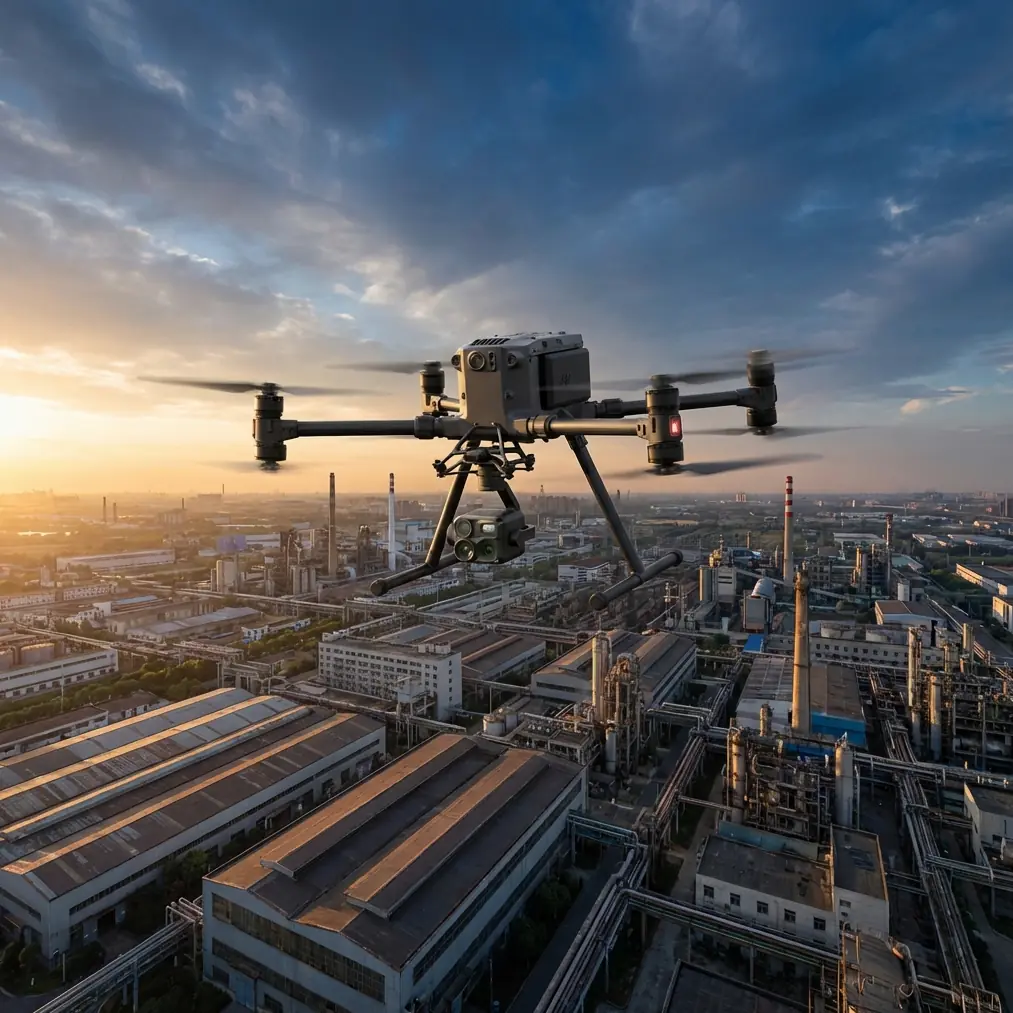
Matrice 4 for Urban Forest Delivery: A Practical Field Guide to Stable Flights, Clean Data, and Safer Handovers
META: Expert Matrice 4 how-to for urban forest delivery missions, covering O3 transmission, AES-256 security, hot-swap battery workflow, thermal signature checks, photogrammetry, GCP use, BVLOS planning, and EMI antenna adjustment.
Urban forest delivery sounds simple until you put a real aircraft into a city edge environment. Trees absorb line of sight. Glass and steel throw radio energy back at you. Rooftops create odd wind behavior. Narrow access corridors leave little room for hesitation. If you are planning to use a Matrice 4 in this setting, the aircraft itself is only part of the job. The rest comes down to how you build a mission around signal integrity, payload accountability, and repeatable handover procedures.
I’ve seen many operators focus first on lift capacity or headline flight time. In dense urban greenery, that is rarely the deciding factor. The flights that succeed are the ones built around communication resilience, precise route geometry, and a disciplined battery and recovery workflow. The Matrice 4 platform is especially well suited to that kind of operation because its transmission stack, security features, and professional mission ecosystem support more than simple point-to-point flying. They support controlled work.
This guide is written for a specific problem: delivering items into or across forested zones inside urban environments, where buildings, canopy, and electromagnetic interference all compete for control of the flight envelope.
Start with the environment, not the aircraft
The phrase “urban forest” covers several very different mission spaces. A riverside greenbelt behind apartment towers. A municipal park with mature canopy and public footpaths. A research arboretum bordered by commercial buildings. A hospital campus with tree-dense grounds. Each one changes how your Matrice 4 should be deployed.
Before route planning, classify the area in three layers:
Vertical clutter
- Tree crown height
- Building height
- Crane activity
- Utility lines and rooftop equipment
Radio clutter
- Cellular installations
- Wi-Fi dense zones
- Reflective façades
- Electrical substations or rail corridors
Ground interaction
- Pedestrian flow
- Vehicle access
- Safe drop or handover zone
- Alternate landing sites
This step matters because transmission stability and navigation confidence often degrade before the pilot notices obvious flight instability. A Matrice 4 can maintain a strong operational profile in difficult spaces, but only if you anticipate the places where signal reflections and occlusions will stack up.
Why O3 transmission matters in tree-and-tower corridors
One of the most operationally relevant features in this mission class is O3 transmission. In clean conditions, operators often think of transmission as a convenience issue: how sharp the feed looks, how smooth control feels. In an urban forest route, it becomes a safety variable.
Canopy breaks line of sight in fragments rather than all at once. You may have a clear path above the crown line, then partial obstruction while crossing between taller trees, then multipath reflection near a building edge. O3 transmission gives the Matrice 4 a more robust control and video link foundation for these transitions, which is essential when you are threading the aircraft through changing visibility rather than flying across an open field.
The significance is practical, not theoretical. A reliable downlink lets the operator read branch clearance, assess landing zone occupancy, and confirm package release conditions in real time. A more stable uplink reduces the chance of delayed pilot response in the exact moments where urban obstacles and foliage are compressing your margin.
In short: in this kind of delivery, transmission quality is not about prettier video. It is about keeping decision-making synchronized with the aircraft.
Handling electromagnetic interference with antenna adjustment
This is the part too many teams treat as an afterthought.
Electromagnetic interference in cities is rarely constant. It spikes around certain façades, telecom hardware, rooftop HVAC systems, tram lines, and densely networked office blocks. If your route crosses from open parkland into a built corridor, the issue may appear only for 10 or 20 seconds, then disappear. Those are the moments where correct antenna handling can prevent a minor signal dip from becoming a broken mission.
When interference begins to show itself, don’t start by overcorrecting the aircraft. First evaluate the control station setup.
Antenna adjustment checklist
- Keep the antenna plane oriented toward the aircraft’s general position rather than pointing the antenna tips directly at it.
- Reposition your body and controller to reduce shielding from nearby metal structures, railings, vehicles, or rooftop housings.
- If possible, take two or three steps laterally rather than backward. Even a small shift can reduce reflected signal paths in a multipath-heavy area.
- Avoid standing under overhangs or beside glass walls when launching or managing final approach.
- If the route repeatedly produces interference at one waypoint, alter the track line slightly rather than trying to “muscle through” the same bad RF pocket every time.
The real significance here is consistency. Once you identify a recurring interference zone, antenna discipline turns it from an unpredictable hazard into a manageable known condition. That is exactly how mature urban drone operations scale.
Secure delivery is not just a logistics issue
For many organizations, especially those moving medical supplies, site-critical tools, or documents, the payload is only half the concern. The mission data matters too. Route plans, video feeds, and operational timing can all be sensitive.
That is where AES-256 becomes more than a technical spec. Encrypted transmission and data handling reduce exposure when you are operating around private facilities, utilities, or enterprise campuses. In a city environment, you are often flying near third-party infrastructure, residential windows, and confidential worksites. A secure operational chain helps teams protect both client expectations and internal procedures.
The significance is straightforward: the more your flights intersect with real-world commercial environments, the less acceptable “good enough” data protection becomes.
Build battery workflow around mission tempo, not percentage anxiety
Battery strategy for urban forest delivery should be designed around predictable turnaround, not endless in-air optimization. The useful detail here is hot-swap batteries. On a Matrice 4 workflow, this feature can materially improve sortie tempo by reducing ground downtime between missions.
That matters more than many operators realize. In delivery scenarios, timing windows are often driven by site access, pedestrian quiet periods, or recipient readiness. If the aircraft is on the ground for extended battery handling and system reset, you start losing the rhythm that keeps a route safe and efficient.
A good hot-swap procedure looks like this:
- Land with a defined reserve rather than pushing every sortie deep into the pack.
- Keep replacement batteries staged, temperature checked, and logged before touchdown.
- Swap in a controlled order with one crew member dedicated to battery handling and another to mission confirmation.
- Confirm route version, payload status, and return profile before relaunch.
The significance is operational continuity. Hot-swap capability is not about rushing. It is about shortening idle time without compromising checks.
Use thermal signature checks for landing zone integrity
Urban forest delivery often happens in partial shade, low-angle light, or cluttered receiving zones. Visual inspection alone can miss people, animals, recently moved equipment, or heat-producing machinery near a handover point.
This is where thermal signature review becomes genuinely useful. Even if thermal isn’t the primary sensor for the mission, it can serve as a rapid verification layer before descent or release. A warm maintenance cart parked under trees, a grounds crew member stepping into the zone, or heat from active equipment can all stand out clearly.
Operationally, this reduces false confidence. The eye sees shape. Thermal often reveals occupancy and activity. That’s especially valuable when the receiving site sits under canopy where contrast is poor and visual clutter is high.
For teams building repeatable delivery operations, a brief thermal scan before final approach can become one of the most efficient risk controls in the entire checklist.
Photogrammetry and GCP are not just for mapping teams
At first glance, photogrammetry and GCP work may seem unrelated to delivery. They are not.
If you are establishing recurring urban forest delivery routes, mapping the corridor and drop sites with photogrammetric methods gives you far better spatial confidence than informal visual scouting. Ground Control Points help tie that model to real-world positional accuracy, which is critical when route tolerances are tight and obstacles are dynamic.
Here is where this becomes powerful:
- You can model canopy height variations over time.
- You can identify whether seasonal growth is shrinking your clearance margins.
- You can measure rooftop and utility offsets accurately.
- You can validate whether a “safe” handover point is still safe after site changes.
The significance is simple. Delivery becomes much safer when the route is built from measured geometry instead of memory. A Matrice 4 program that combines delivery operations with periodic photogrammetry can maintain route quality instead of letting it drift.
BVLOS planning in urban green corridors needs discipline
Some operators are interested in BVLOS applications for longer urban edge routes or networked campus delivery. That can be appropriate in the right regulatory framework, but the planning standard has to be much tighter than for open-area work.
Urban forest environments create intermittent visibility and changing communication quality, so BVLOS route design should include:
- Conservative altitude selection above canopy while respecting local constraints
- Defined communication recovery points
- Alternate landing or hover decision nodes
- Weather triggers specific to gusting around buildings and treetops
- Clear handover procedures if the receiving site becomes occupied
The important point is that BVLOS in these environments should never be treated as simply “farther VLOS.” It is a different operational problem. The Matrice 4 ecosystem can support sophisticated planning, but the mission architecture has to match the environment.
A sample mission flow for urban forest delivery
To make this concrete, here is a practical workflow I would use.
1. Pre-site survey
Walk the route endpoints and identify:
- Tree lines
- reflective surfaces
- likely EMI sources
- public movement patterns
Capture a baseline map and note where antenna orientation may become critical.
2. Route modeling
Use photogrammetry to create a current corridor model. Place GCPs where precision matters most, especially near launch, handover, and alternate recovery points.
3. RF rehearsal
Conduct a non-delivery proving flight. Watch for control or video degradation near buildings and dense canopy transitions. Log where antenna adjustments improve link quality.
4. Security setup
Enable secure mission handling practices and ensure AES-256 protected workflows are used where data sensitivity warrants it.
5. Delivery sortie
Launch with enough reserve to abandon approach if the receiving zone changes. Use thermal signature checks before descent. Keep the route smooth and predictable rather than aggressively efficient.
6. Battery turnaround
Use hot-swap batteries with a crew-led relaunch protocol. Battery replacement should be fast, but the confirmation step should never be skipped.
7. Post-flight review
Compare actual link behavior with your RF expectations. Update route design if interference appears in repeatable patterns.
What crews often get wrong
The most common mistake is assuming trees are the main challenge. Often they are not. The real issue is how trees combine with buildings to create blind segments, reflected radio paths, and inconsistent visual references.
The second mistake is treating sensor options as isolated tools. In practice, delivery, thermal verification, and corridor mapping work best when they are combined. Thermal signature checks improve landing zone awareness. Photogrammetry and GCP improve route precision. O3 transmission supports control continuity. AES-256 secures the operational layer. Hot-swap batteries preserve sortie cadence. None of these details stands alone. Together, they create a delivery system that is far more resilient than a basic “fly there and drop” setup.
The third mistake is poor pilot positioning. If you know a segment is vulnerable to electromagnetic interference, don’t wait for trouble to improvise. Choose your launch and supervision point with the RF environment in mind. Antenna adjustment is only effective if the operator has room to move, clear orientation to the aircraft’s route, and minimal shielding from nearby structures.
When Matrice 4 makes the most sense here
Matrice 4 is strongest in this scenario when the mission needs more than lift and flight time. It makes sense when the operator needs dependable transmission in cluttered space, secure data handling, repeatable battery turnover, and multi-sensor support for route validation and handover safety.
That is why it fits urban forest delivery better than a simplistic checklist might suggest. These missions are not just about moving an item from point A to point B. They are about doing that in a space where signal quality, environmental variability, and landing zone certainty all change minute by minute.
If your team is building an operation like this and wants to sanity-check route design, RF handling, or battery workflow, you can reach out directly through this Matrice 4 field support channel.
The operators who do well with Matrice 4 in urban forest delivery are usually the ones who think like systems designers. They map first. They test RF behavior. They use thermal intelligently. They build battery procedures that support tempo without cutting corners. And they understand that in dense mixed environments, small adjustments in antenna orientation or route geometry can have outsized effects on safety and mission completion.
Ready for your own Matrice 4? Contact our team for expert consultation.