
Matrice 4 on a Frozen Jobsite: A Real Inspection Workflow
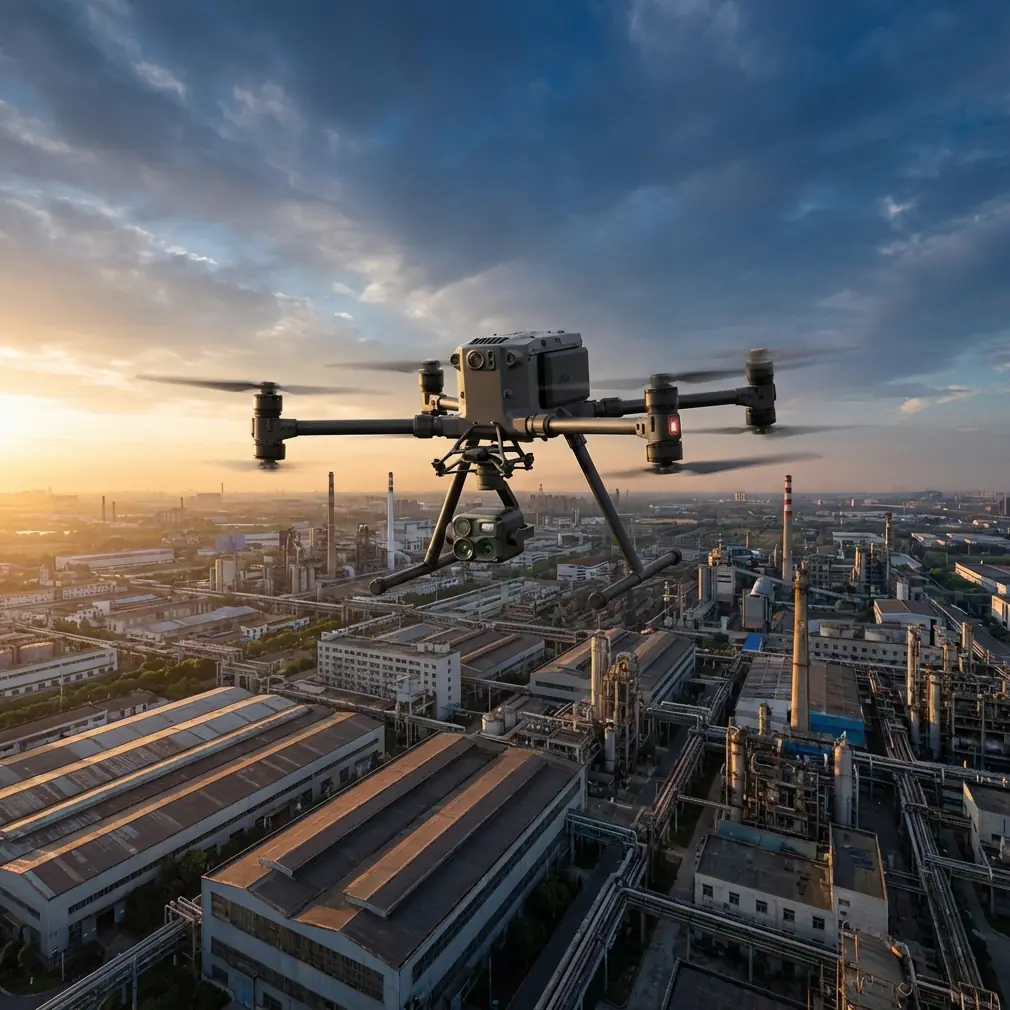
Matrice 4 on a Frozen Jobsite: A Real Inspection Workflow for Extreme-Temperature Construction Surveys
META: A field-tested Matrice 4 case study for construction site inspection in extreme temperatures, covering thermal work, photogrammetry, EMI handling, O3 transmission, AES-256 security, and battery strategy.
Winter exposes problems that a summer site can hide.
Steel contracts. Temporary power systems behave unpredictably. Concrete curing becomes a daily risk calculation rather than a routine checklist. On large construction projects, especially those spread across multiple elevations and partially enclosed structures, the inspection burden rises just as conditions become less forgiving. That is where a Matrice 4-class workflow earns its place—not as a flashy add-on, but as a tool for reducing uncertainty when the site itself is fighting back.
This case study focuses on a cold-weather construction inspection scenario built around Matrice 4 operations. The mission: assess structural progress, verify thermal anomalies around building envelope sections, map stockpile and access changes, and maintain reliable command links in a site full of cranes, rebar, temporary communications gear, and reflective steel. The challenge was not simply flying in low temperatures. It was collecting usable data without letting environmental stress, electromagnetic interference, or battery logistics break the workflow.
The jobsite problem wasn’t visibility. It was confidence.
A superintendent can walk a site and see a lot. What they often cannot see is whether a heat trace line is underperforming behind a façade section, whether moisture risk is developing along a roof transition, or whether a staging area has drifted enough from the digital plan to affect crane movement and material routing.
That gap between what is visible and what is verifiable matters more in extreme conditions. A thermal signature that looks minor at noon may indicate a major insulation discontinuity once temperatures drop further overnight. A stockpile volume estimate that seems close enough on the ground can be wrong enough to disrupt procurement or sequencing. In cold weather, “close enough” becomes expensive.
Using Matrice 4 for this kind of operation means combining thermal inspection with photogrammetry rather than treating them as separate missions. That pairing is what turns images into decisions. Thermal identifies where the building is behaving oddly. The map and model show exactly where that anomaly sits in relation to framing, access routes, façade zones, and work packages.
Mission design started with the environment, not the aircraft
The site itself created three constraints.
First, temperature. Battery performance and sensor readiness had to be managed from the first lift, not after the first warning message. Second, electromagnetic clutter. The project had tower cranes, site radios, temporary network nodes, and a dense mix of steel members that could scatter signals in awkward ways. Third, continuity. The team needed repeated sorties throughout the day, so battery changes had to be fast and predictable.
This is where hot-swap batteries mattered operationally. They were not just a convenience feature. They allowed the crew to maintain mission tempo between thermal passes at daybreak and mapping flights later in the morning without long interruptions that would have changed lighting conditions and thermal comparability. On an inspection day, continuity is data quality.
The payload strategy also reflected the site’s priorities. Early flights focused on thermal signature collection around envelope joints, roof edges, temporary heated enclosures, and newly installed mechanical runs. Once those targets were identified, the team shifted to photogrammetry with defined overlap and GCP-supported control points to produce accurate orthomosaics and surface models.
GCP use is often treated as optional on active sites. In this case, it was not. Ground control points gave the project team a stronger positional baseline for comparing repeated surveys, especially where earthworks, access roads, and laydown yards were changing week to week. If the purpose of the map is progress accountability, then repeatability matters as much as image sharpness.
Thermal data only helped because it was tied to the build sequence
One of the most useful findings came from a perimeter section where temporary enclosure panels had already passed a visual check. The thermal layer showed a persistent cold-band pattern along a connection line that looked minor in isolation. Once overlaid against the site model and installation schedule, it became clear that this was a transition zone between crews and installation phases. The issue was not random heat loss. It was a repeatable execution gap.
That is the difference between collecting imagery and conducting inspection.
The thermal signature told the team where the envelope was underperforming. The photogrammetry output established the exact installed condition. The construction schedule explained why the anomaly existed. A Matrice 4 mission can provide the first two pieces quickly; an experienced workflow connects them to the third.
This matters because extreme-temperature inspections are not only about defect hunting. They are about prioritization. On a large site, you can find dozens of thermal irregularities. The real value lies in identifying which ones relate to active works, which ones pose near-term risk, and which are simply artifacts of temporary conditions.
O3 transmission became critical when the crane corridor turned noisy
The most delicate part of the day came during an orbit around a steel-framed section near two tower cranes. Video quality remained usable, but the crew began to see intermittent signal instability consistent with a high-interference corridor. This is where O3 transmission performance and good operator discipline mattered more than raw range claims.
The fix was not dramatic. It was procedural.
The pilot adjusted antenna orientation to maintain stronger geometry relative to the aircraft’s path, then repositioned the ground station a short distance to reduce shielding from stacked materials and steel containers. That small move improved link stability enough to continue the pass without compromising the capture plan. On cluttered jobsites, electromagnetic interference is often less about a single source than about layered reflections and blocked line-of-sight. Antenna adjustment sounds basic because it is basic, but it remains one of the highest-value habits on professional drone crews.
Construction teams preparing for similar conditions often ask what they should do first when interference appears. The answer is usually not “push through.” Reassess aircraft position, operator stance, antenna angle, and nearby obstacles before you blame the platform. If your team wants a practical workflow discussion for site-specific conditions, this field coordination chat is a useful starting point.
Security was part of the workflow, not an afterthought
Construction sites increasingly involve sensitive information: structural progress, subcontractor sequencing, utility routing, façade details, and proprietary installation methods. On major projects, inspection imagery is not casual media. It is project intelligence.
That made AES-256 relevant in a very practical way. Secure transmission and protected data handling support client trust, especially when survey outputs are shared across owners, consultants, and contractors. For teams working on critical infrastructure, energy, transport, or high-value urban developments, secure handling is not a nice checkbox. It is part of being allowed on the site in the first place.
This also shaped file management. Thermal captures flagged for envelope review were separated from broader progress mapping sets, and only the required stakeholders received each layer. A disciplined drone program is not just about collecting more data than a walk-through. It is about controlling who can act on it.
Why traditional aircraft design lessons still matter for drone inspection thinking
Two engineering references help explain why disciplined UAV inspection operations matter, even on civilian construction sites.
The first comes from a flight control design handbook that emphasizes how system stiffness often cannot be trusted from calculation alone and must be verified through testing. One passage describes loading the control system to 67% of design load and measuring force and displacement to determine actual stiffness. Another describes increasing input frequency until a displacement peak identifies the system’s natural frequency. The operational takeaway is larger than the hardware itself: real systems behave differently under load than they do on paper.
That principle applies directly to a Matrice 4 construction workflow in harsh weather. You do not assume radio behavior from a spec sheet when cranes, steel decking, temporary generators, and cold-soaked batteries are in play. You validate in the field. You test link quality in the actual corridor. You watch for response changes near reflective structures. You verify aircraft and payload behavior before the critical pass.
The same reference also notes that control systems without redundancy may require replacement or repair as soon as cracks or damage are found, rather than relying on damage-tolerance assumptions. In drone terms, that reinforces a conservative maintenance culture for inspection fleets. If your aircraft is routinely operating around abrasive dust, cold starts, and repetitive transport between sites, small physical defects should not be normalized.
The second reference comes from a helicopter design text focused on structural load paths. One example explains how torque can be transferred through 31 bolts into the fuselage connection frame and then distributed through surrounding structure. Another discusses how landing loads are transmitted directly from landing gear connections into frames and beams. These are manned-aircraft examples, but the lesson is familiar to anyone inspecting construction with UAVs: loads are never isolated. They move through connection points, interfaces, and structural paths.
That mindset helps when interpreting drone data on a jobsite. If thermal irregularity appears around a façade bracket line, the question is not just what the panel surface shows. It is how that condition may relate to the attachment path, adjacent materials, and local sequencing. If deformation appears in a temporary ramp or elevated deck area, the answer is not simply to photograph the spot. The answer is to understand what load path feeds it. Good aerial inspection is structural thinking applied to image collection.
BVLOS conversations should start with mission need, not ambition
Many teams looking at Matrice 4 ask about BVLOS right away. Fair enough. Larger sites and corridor-style developments create real pressure to expand operational reach.
But on active construction projects, BVLOS value depends on workflow maturity. If your site team has not already standardized launch zones, observer coordination, battery staging, EMI response, GCP placement, and data handoff, BVLOS will not fix your bottleneck. It will magnify it.
For this case, the team stayed within a tightly controlled visual operation because the site geometry, crane movement, and changing access conditions demanded close coordination. That was the right call. BVLOS becomes useful when it supports repeatability and coverage, not when it is used to compensate for weak field discipline.
What the project team actually gained
By the end of the inspection cycle, the site team had four things they did not have that morning.
They had a thermal-backed shortlist of envelope zones needing immediate review. They had a current photogrammetric map tied to GCPs for higher-confidence comparison against previous progress records. They had verified that certain interference-prone airspace near crane lines required modified pilot positioning and antenna handling. And they had preserved a steady sortie rhythm because hot-swap battery management kept environmental timing from slipping away.
Those are practical gains. Not abstract ones.
The reason Matrice 4 fits this type of work is not that it magically solves extreme weather. It is that it supports a professional inspection method: secure data handling, stable transmission, thermal and visual capture in one operational flow, and enough field flexibility to adapt when the site pushes back.
That matters most on the days when the job is least forgiving. Cold air, noisy spectrum, reflective steel, and compressed schedules have a way of exposing weak processes. A solid drone workflow does the opposite. It reveals where the build needs attention while keeping the inspection itself under control.
For construction leaders, that is the real benchmark. Not how cinematic the footage looks. Whether the aircraft helped the team make a better decision before a small issue turned into a winter delay.
Ready for your own Matrice 4? Contact our team for expert consultation.