
Matrice 4 on Uneven Ground: What Complex
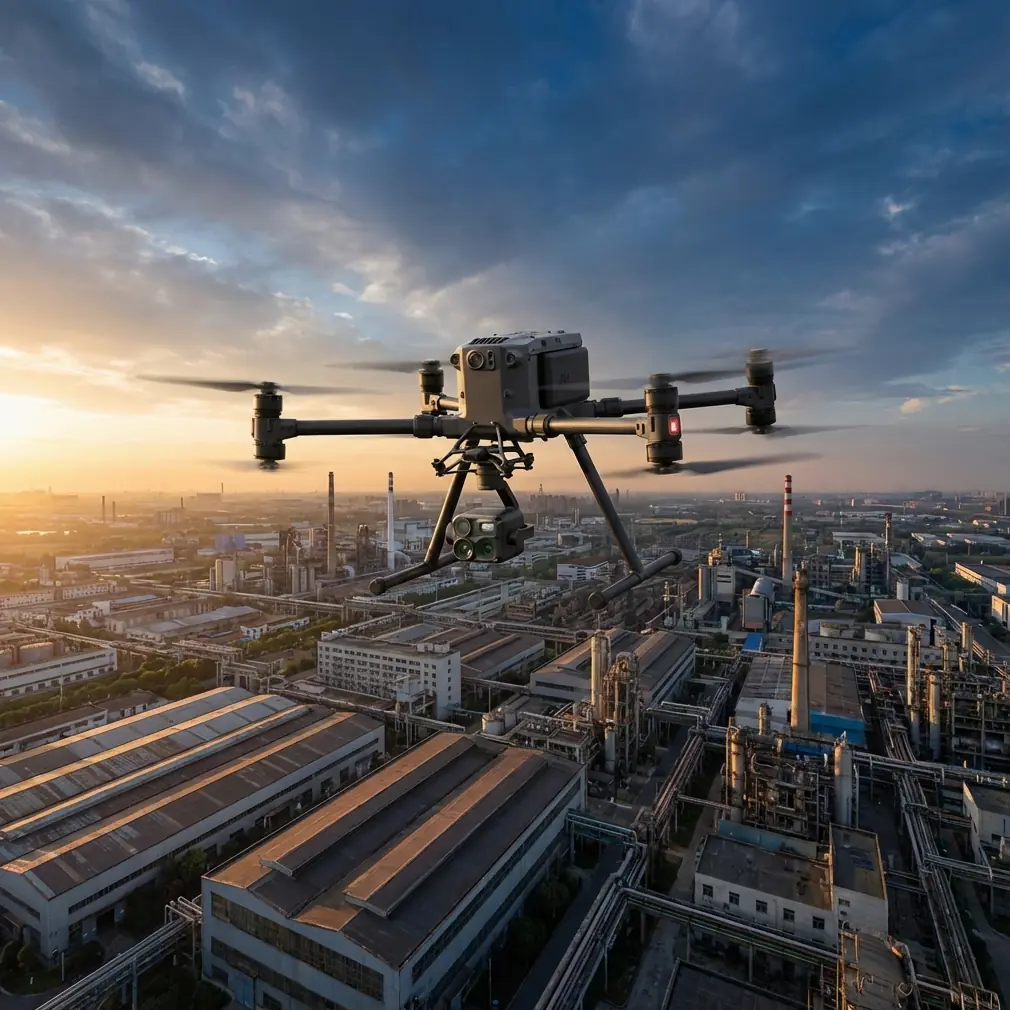
Matrice 4 on Uneven Ground: What Complex-Terrain Solar Surveys Really Demand
META: A field-driven look at how Matrice 4 supports solar farm surveying in complex terrain, with practical insight on materials, vibration tolerance, thermal work, photogrammetry, and changing weather.
Solar farm surveys sound tidy on paper. Long rows. Repeatable geometry. Predictable data capture.
Then you get to the site.
The access roads cut across slope breaks. Panels step down along ridgelines. Heat shimmer rises off dark surfaces by late morning. Wind behaves one way in the low basin and another over the crest. And if your deliverable includes both photogrammetry and thermal signature analysis, you are no longer “just flying a drone.” You are managing a moving measurement system in a harsh microclimate.
That is exactly where a platform like Matrice 4 becomes interesting—not because of marketing abstractions, but because complex-terrain solar work punishes weak engineering choices. In my view, the real story is not only flight performance. It is how structural materials, bonded assemblies, and flexible internal routing decisions quietly shape data quality when weather changes mid-flight.
The hidden problem in solar-farm mapping: stability under shifting loads
For a utility-scale solar survey, clients usually care about a few outcomes:
- accurate orthomosaics and elevation products from photogrammetry
- reliable hotspot detection through thermal signature review
- repeatable geospatial control using GCP workflows
- clean transmission links across rolling terrain
- enough endurance and battery logistics to finish sectors without breaking continuity
Those are the visible requirements. Underneath them sits a less glamorous one: the aircraft has to remain dimensionally and mechanically consistent while the environment changes.
That matters more than many operators admit.
When a drone traverses a solar site with sharp elevation changes, it sees fluctuating wind loading, changing surface temperatures, and repeated attitude corrections. A brief gust over a ridge can do more than nudge the aircraft off line. It can impose transient shear loads through the airframe and internal assemblies. If the platform’s structure, adhesive interfaces, or flexible conduits are poorly designed, tiny shifts can accumulate into bigger consequences: degraded image overlap, thermal blur, calibration drift, or vibration patterns that complicate downstream processing.
This is where the reference material becomes surprisingly relevant to a modern Matrice 4 discussion.
Why old aerospace handbook data still matters to a new drone platform
One source excerpt focuses on bonded honeycomb materials—specifically 5052 and 5056 aluminum honeycomb core data under elevated temperature conditions. The table lists minimum stabilized flatwise panel shear strength at 350°F, with values that rise significantly as core configuration changes. For example, one entry shows 1.0 lb/ft², 3/8 in, 0.0007 material at relatively low values such as 13 and 23 psi, while a denser configuration at 5.4 lb/ft², 3/8 in, 0.0010 reaches 367 and 441 psi in the corresponding columns.
That may look far removed from a drone over solar panels. It is not.
Solar sites create one of the least forgiving civilian inspection environments for lightweight aircraft because they combine reflected heat, dark absorber surfaces, and rapid transition between cooler air and radiant hot zones. Even if an airframe is nowhere near 350°F, elevated-temperature stability is still the right engineering mindset. Adhesive-bonded sandwich structures and lightweight panel systems are valued in UAV design because they deliver stiffness without excessive mass. But the number that matters in the field is not just strength in a lab. It is whether the structure stays stable enough that the payload can maintain calibration and the aircraft can absorb repeated micro-loads without introducing noise into the data.
Operational significance: a stiffer, better-stabilized structure supports more consistent image geometry during photogrammetry runs and cleaner thermal capture when the aircraft is correcting for terrain-driven airflow.
The second reference excerpt deals with flexible duct or conduit connections using rubber sleeves and clamps, including standardized arrangements such as HB4-87-4 and dimensional entries like 30 | 49 and 105 | 124. At first glance, this seems like pipework trivia. In practice, it speaks to another underappreciated issue in drone design: the management of internal routing under vibration and flex.
Any commercial UAV carrying multiple sensors, power lines, cooling paths, or gimbal-adjacent wiring benefits from controlled flexibility. Too rigid, and components transmit shock. Too loose, and movement creates wear, resonance, or intermittent instability. Standardized flexible connections exist to preserve sealing and integrity while still allowing the system to breathe mechanically.
Operational significance: internal cable and conduit management affects vibration isolation, environmental sealing, and long-term reliability—three factors that directly influence survey repeatability on rough sites.
A real field scenario: weather changed in the middle of the mission
Let’s put this in practical terms.
On a solar survey in broken terrain, the morning can begin with ideal conditions: stable light, moderate breeze, cool module temperatures, and excellent visibility for GCP identification. You launch the Matrice 4 with a photogrammetry-first plan, expecting to follow with a thermal pass once the irradiance profile shifts into a better inspection window.
Halfway through the grid, the weather turns.
A crosswind starts spilling over the higher ground. The temperature rises faster than forecast. Airflow becomes uneven over panel arrays where the land benches downward in irregular steps. That combination usually exposes weaknesses in both aircraft control and mission planning.
What matters then is not whether the drone can simply remain airborne. What matters is whether it can continue collecting useful data.
A capable Matrice 4 workflow in that moment depends on several layers working together:
1. Flight stability over terrain transitions
Complex terrain generates changing relative altitude and disturbed air. The aircraft must preserve overlap and track spacing despite frequent micro-corrections. In photogrammetry, those corrections are not free. Each one can affect motion blur, perspective consistency, and the quality of reconstruction on sloped surfaces.
This is where structural stiffness and controlled internal flexibility matter. The aerospace material references point to exactly the kind of design philosophy that separates a survey-grade platform from a casual imaging drone: high shear-capable bonded structures, paired with flexible connection strategies that reduce stress concentration and preserve system integrity.
2. O3 transmission in awkward topography
Solar farms in complex terrain rarely offer a clean line of sight from every point in the mission block. Small rises can interrupt signal geometry, especially when arrays extend behind contours. Strong transmission resilience matters because terrain can make a healthy link appear marginal very quickly.
For Matrice 4 users, O3 transmission is not just a spec-sheet convenience. In this application, it supports confidence when the aircraft passes across uneven landforms and reflective surfaces. Maintaining command and video stability lets the pilot assess whether the mission should continue, pause, or transition to a modified route as the weather shifts.
3. AES-256 for infrastructure data handling
Utility assets carry sensitivity even in fully civilian work. High-resolution maps, thermal anomaly records, and layout intelligence are operationally valuable. AES-256 matters here because survey data is not merely visual media; it often becomes part of maintenance planning, asset management, and contractor coordination.
On large solar sites, teams increasingly move data quickly between field and office. Secure transmission and storage practices help protect project integrity without slowing the workflow.
4. Hot-swap batteries and continuity under pressure
Weather changes rarely happen at a convenient moment. If battery replacement forces a long interruption, the thermal scene can drift, shadows can shift, and your stitch consistency can suffer.
Hot-swap batteries matter because they reduce the gap between flight segments. On a site where sunlight, wind, and module temperatures are changing by the minute, continuity is a quality control advantage, not just an operational convenience.
Why thermal and photogrammetry should not be treated as separate missions
A common mistake in solar operations is to separate “mapping” from “inspection” too rigidly. In reality, each informs the other.
Photogrammetry provides the geometric base map. It tells you where every array row, service track, drainage line, and terrain transition sits in space. Thermal signature analysis then adds condition intelligence: hotspots, mismatched string behavior, or suspicious heat patterns that deserve follow-up.
On complex terrain, the challenge is that topography influences both datasets differently. Slopes affect viewing geometry in photogrammetry. Heat retention and airflow affect thermal readings. A Matrice 4 mission should therefore be designed as one integrated survey architecture rather than two unrelated flights.
That means:
- placing GCPs where they remain visible across slope changes
- choosing flight timing that respects thermal behavior, not just sunlight availability
- planning overlap with terrain-induced pitch and roll adjustments in mind
- preserving data continuity across battery events
- monitoring weather shifts aggressively, especially when wind begins to diverge across elevations
If you are trying to refine a workflow for your own terrain-heavy solar inspections, our field team is reachable on WhatsApp for practical mission planning.
The structural lesson operators usually miss
Most UAV discussions fixate on payload specs, AI features, or endurance. Those matter. But for surveying solar farms in broken terrain, the deeper question is whether the aircraft is built like an instrument.
The reference on honeycomb core shear strength gives a useful clue. The spread from 13 psi at a very light configuration to over 400 psi in a much more robust one is not a trivial material difference. It represents the engineering trade-off between low mass and meaningful load stability. Drone designers live inside that trade every day.
Likewise, the standard flexible connection references—dimensions such as 30 to 49 and 105 to 124, tied to part families like HB4-84 and HB4-118—reflect the importance of consistency in how movement is accommodated. Good systems do not pretend vibration and flex can be eliminated. They control them.
For Matrice 4 operators, this matters because consistent data starts with a mechanically coherent aircraft. A thermal payload is only as trustworthy as the platform carrying it. A photogrammetry model is only as clean as the geometry maintained during capture.
BVLOS thinking, even when you are not flying BVLOS
Many solar sites are large enough that teams think in BVLOS terms even when operating within current line-of-sight constraints. The reason is simple: mission design changes when the site footprint and terrain complexity stretch operational awareness.
Matrice 4 workflows benefit from borrowing that discipline:
- segment the site by topographic behavior, not just acreage
- define link-risk zones where ridges or array blocks may complicate transmission
- pre-plan alternate battery swap points
- establish thresholds for wind change, not just average wind speed
- decide in advance when thermal data quality has degraded enough to justify a re-flight
This approach turns weather changes from a surprise into a managed variable.
What I would prioritize on a Matrice 4 solar mission
If the job is a solar farm in complex terrain, my priorities would be straightforward:
First, build the mission around terrain rather than around the site boundary. Long, neat corridors look efficient until they cross airflow regimes that produce unstable capture.
Second, anchor the geometry with disciplined GCP placement. Sloped sites expose weak control fast.
Third, watch thermal timing closely. The best thermal signature window is not always the most convenient flight window.
Fourth, treat transmission integrity as part of data quality. O3 is valuable not because range sounds impressive, but because broken terrain can punish weak links.
Fifth, use battery workflow strategically. Hot-swap capability can protect continuity when weather is shifting.
And finally, respect the hardware as an engineered measurement platform. The aerospace references here—adhesive-bonded honeycomb panel shear behavior at elevated temperature, and standardized flexible connection design—point to a truth every serious operator eventually learns: reliable survey data begins long before the camera shutter fires.
That is why Matrice 4 belongs in this conversation. Not as a generic “smart drone,” but as a platform whose value appears when the terrain is awkward, the heat is uneven, the wind changes halfway through the mission, and the client still expects mapping-grade output with inspection-grade confidence.
Ready for your own Matrice 4? Contact our team for expert consultation.